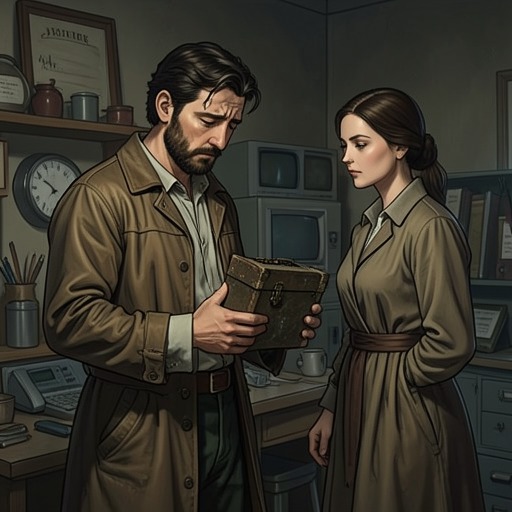
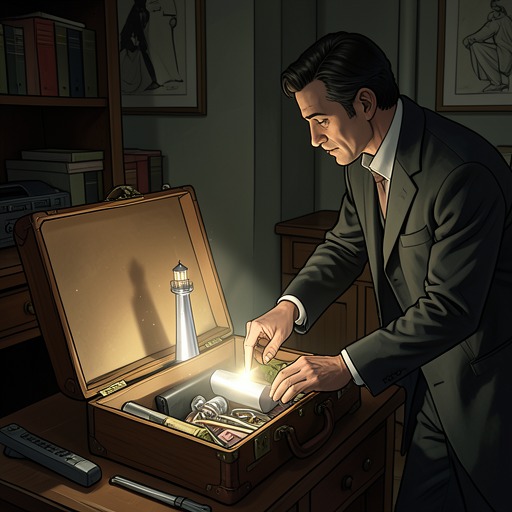
Futh’s silver lighthouse perfume case
The Lighthouse (Alison Moore Edition)Futh’s silver lighthouse perfume case is both a surviving family heirloom and a portable store of absence. Its ornate shell outlasts the perfume vial that once gave it purpose, and Futh carries the empty case long after the scent inside has spilled into a wound. Passed through several hands but never returned to the relative meant to inherit it, the object binds together Futh’s memories of his mother, a broken family promise, and the repeated possibility of loss.
Form and Inheritance
The case is a small silver-plated lighthouse, roughly ten centimetres tall and three or four centimetres across, with a four-sided tower, tiny storm panes around its lantern room, and a domed top. One side bears the name DRALLE, an old Hamburg perfumery. It was made to hold a cut-glass vial of expensive perfume; by the time Ester finds it among Futh’s clothes, that vial is gone and the case is empty. The lighthouse is elaborate enough to invite close attention, yet its surviving exterior encloses no fragrance.
Its family history reaches back to Futh’s German great-grandmother. During a visit to his widowed grandfather in London, Futh’s father receives the heirloom with instructions to return it to Ernst, his father’s brother. The grandfather explains that it belonged to their mother and should go back to Ernst. The case therefore enters the family not as an unambiguous gift but as an object entrusted for return. Its later journey carries that unfinished obligation along with it.
When Futh’s father gives the case to Futh’s mother in the car, she admires it and approves of the perfume. She applies the scent to her wrists and throat, and the car fills with violets. The object’s family history is thereby joined to a close, bodily memory of Futh’s mother: not only a precious possession in a family chain, but a container associated with the smell she wore.
Breakage and the Loss of the Scent
The decisive change occurs during the family holiday on the cliffs in Cornwall. As Futh’s father talks about lighthouse signals and the warnings intended to prevent shipwrecks, Futh wanders away carrying the case. He removes the glass vial because he wants to smell his mother’s perfume, but does not take out its stopper. The object’s protective design cannot prevent what happens next: after his mother tells Futh’s father how much he bores her, Futh looks down and discovers that the vial has broken in his hand. The glass cuts the fleshy pad beneath his thumb; the perfume runs over the wound and between his fingers, soaking his boots.
The case remains, but its contents become an injury and a scent released beyond recovery. Futh raises his palm to his nose for a long time afterwards, searching for the smell of violets. On the train home, the broken vial is still inside the case in his pocket; his hands and boots smell strongly of violets, while his mother smells of the orange she ate before falling asleep. The contrast makes the perfume more than a keepsake: its particular scent marks the distance between Futh and his mother even as it briefly clings to his body. Years later, when his work involves manufacturing artificial odours, octyl acetate makes him feel sad, another sensory link to that journey and its impending separation.
A Portable Heirloom
The case persists after Futh’s mother leaves. Futh’s father burns her belongings and cleans the house, but Futh continues to carry the lighthouse with him. In adulthood he takes it on his travels, keeping it in his pocket as if it were a Saint Christopher. The comparison suggests a talismanic use, but the object offers no practical protection: its original vial is broken, and the past it represents cannot be restored by keeping it close.
Its physical presence shifts between reassurance and discomfort. On the ferry, Futh removes the small silver lighthouse from his trouser pocket and places it in a side pocket of his overnight bag so it will not roll away or get lost. Later, while walking, he becomes acutely conscious of it pressing against his groin with every step. For the first time, he wishes it were not in his pocket and decides it could travel in his suitcase instead, making him lighter. The cherished object has become a burden as well as a companion, its weight making the history he carries materially difficult to ignore.
Futh also takes it to Germany as a boy when he and his father visit Ernst. He keeps it hidden in the secret inner pocket of his kagoul, while his father conceals their passports and Deutschmarks in his own. The house is standing and well maintained, though they do not know in advance whether Ernst is alive or whether they will find anyone there. During the visit, the family account of the missing heirloom becomes explicit: the valuables taken when Futh’s grandfather left were returned by post, except for a perfume bottle in a silver case. Ernst says the case should have been returned to him, since it belonged to his mother and was his inheritance. Futh’s father replies that the bottle has been broken. The case thus arrives at its intended destination in proximity, but its history and damage do not amount to its return.
Ester and the Empty Case
Years later, Ester notices the lighthouse in the pocket of Futh’s gravy-stained trousers while looking through his suitcase. She examines its precise shape and the DRALLE marking, recognizes that such a case ought to contain an expensive perfume vial, and finds it empty. The discovery connects the object’s present emptiness to Ester’s own long-standing attention to perfume. As a child, she collected the sample fragrances her travelling mother brought home, and she once attempted to make a scent of her own. Perfume is therefore not incidental decoration in the encounter: Ester knows the culture of scents and the possibilities the case once contained.
Ester briefly considers taking it. As Futh finishes showering, she drops the lighthouse back onto his clothes, starts to leave, then hesitates and steps toward the bed again, watching the object. Hearing him move toward the bathroom door, she turns away and leaves the room. In a later scene, Futh watches from the bathroom as Ester picks up the silver lighthouse from the dressing table and puts it away in a drawer. The object’s movements through these rooms make it newly vulnerable to other people’s decisions: it can be noticed, handled, hidden, and separated from its owner, even while Futh remains attached to it.
Meaning and Unresolved Return
The lighthouse case gathers distinct forms of loss without resolving them. It is inherited property with a named intended heir, a vessel whose perfume has vanished, a remnant of Futh’s mother after her departure, and an object Futh repeatedly transports rather than relinquishes. Its polished, recognizable form contrasts with the broken vial it once protected; its lighthouse shape evokes warning and safety, while its own history includes a breakage that could not be prevented and an inheritance that does not reach its claimant.
Its persistence is also sensory and bodily. Violets recall Futh’s mother and the moment the vial breaks; later, the empty case itself carries no scent, but its presence prompts Futh to keep searching through memory and habit. In the bathroom, the smell of camphor from another bottle abruptly takes him back to the dark, mothball-scented interior of his mother’s wardrobe. That recollection clarifies the limits of the silver lighthouse as a memory object: it preserves one vivid trace, but not the whole atmosphere he longs to recover. The case survives, travels, and changes hands, while the perfume and the family intimacy attached to it remain irretrievable.